
Knowledge
[Basic Knowledge for Selecting Fans]



Factory automation (FA) equipment contains many heat‑generating components, such as motors and control boards. Cooling with fans plays a critical role in ensuring stable operation and preventing failures. Adequate cooling suppresses temperature rise inside the equipment, which in turn reduces the risk of malfunctions and system breakdowns.
In addition, efficient cooling extends equipment service life and improves energy efficiency, which contributes to lower maintenance and operating costs.
Furthermore, equipment used in factory environments may be exposed to harsh conditions such as oil mist and dust . To ensure stable operation under these conditions, cooling fans with high environmental resistance and durability are required.
In this article, we introduce where cooling fans are installed in FA equipment, as well as the types of fans commonly used.

Let’s take a look at which parts of FA equipment are equipped with cooling fans.
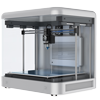 3D Printer
Wide Temperature Range Fans, which are capable of operating across a broad temperature range, maintain stable performance even in high-temperature areas such as around the nozzle during printing or inside heated chambers. This ensures reliable protection of electronic components and consistent print quality.
 3D Printer
Wide Temperature Range Fans, which are capable of operating across a broad temperature range, maintain stable performance even in high-temperature areas such as around the nozzle during printing or inside heated chambers. This ensures reliable protection of electronic components and consistent print quality.
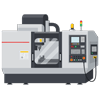 CNC Lathe
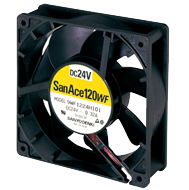
Oil Proof Fans maintain stable operation even in harsh environments where oil mist is present.
 CNC Lathe
Oil Proof Fans maintain stable operation even in harsh environments where oil mist is present.
 Industrial Assembly Robot Arm (Inverter)
Oil Proof Fans maintain stable operation even in harsh environments where oil mist is present.
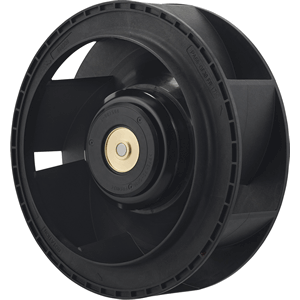
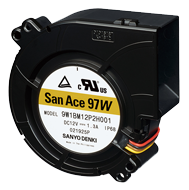
In environments where dust is generated, Splash Proof Centrifugal Fans or Splash Proof Blowers with dust protection are suitable.
 Industrial Assembly Robot Arm (Inverter)
Oil Proof Fans maintain stable operation even in harsh environments where oil mist is present.
In environments where dust is generated, Splash Proof Centrifugal Fans or Splash Proof Blowers with dust protection are suitable.
 Industrial Robot Arm for Material Handling (Servo Motors and Controllers)
For robot arm servo motors, Oil Proof Fans that can maintain stable operation even in environments exposed to oil mist are suitable. Meanwhile, for controllers, Low Power Consumption Fans that contribute to reduced power usage and lower environmental impact are recommended.
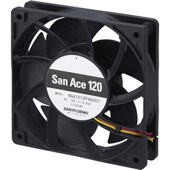 Industrial Robot Arm for Material Handling (Servo Motors and Controllers)
For robot arm servo motors, Oil Proof Fans that can maintain stable operation even in environments exposed to oil mist are suitable. Meanwhile, for controllers, Low Power Consumption Fans that contribute to reduced power usage and lower environmental impact are recommended.
 Press machine
In harsh environments where dust is present, Splash Proof Fans with dust-protection performance are suitable.
In addition, for cooling electrical enclosures and motors, Counter Rotating Fans with high static pressure are sometimes used.
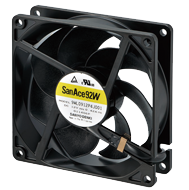
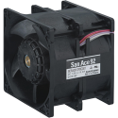 Press machine
In harsh environments where dust is present, Splash Proof Fans with dust-protection performance are suitable.
In addition, for cooling electrical enclosures and motors, Counter Rotating Fans with high static pressure are sometimes used.
 Inspection Equipment
In the FA field, inspection equipment includes image processing and visual inspection systems that detect surface defects, measurement and dimensional inspection systems for measuring minute dimensions, and electrical performance inspection systems that evaluate the electrical characteristics and operation of printed circuit boards and electronic devices.
Fans are installed in these systems to cool internal components, ensuring stable operation and extending equipment service life.
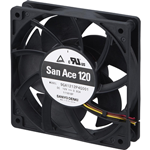 Inspection Equipment
In the FA field, inspection equipment includes image processing and visual inspection systems that detect surface defects, measurement and dimensional inspection systems for measuring minute dimensions, and electrical performance inspection systems that evaluate the electrical characteristics and operation of printed circuit boards and electronic devices.
Fans are installed in these systems to cool internal components, ensuring stable operation and extending equipment service life.
 Control Panel
Cooling fans are installed to dissipate heat inside enclosures, ensuring stable operation and extending the service life of electronic components. With wide input‑range ACDC Fans, operation is possible with both AC 100 V and AC 200 V power systems, while maintaining a stable rotational speed regardless of input voltage or frequency.
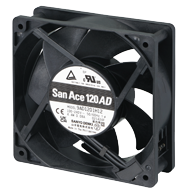 Control Panel
Cooling fans are installed to dissipate heat inside enclosures, ensuring stable operation and extending the service life of electronic components. With wide input‑range ACDC Fans, operation is possible with both AC 100 V and AC 200 V power systems, while maintaining a stable rotational speed regardless of input voltage or frequency.
In factory environments, fans may be exposed to harsh operating conditions such as high ambient temperatures, oil splash, and airborne dust. Under these conditions, it is important to select fans with specifications that are appropriate for the intended operating environment.
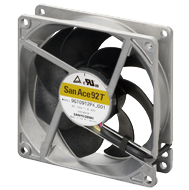
Wide Temperature Range Fans that incorporate highly durable components and robust structural designs ensure stable operation under high ambient temperature conditions, which contributes to reduced maintenance requirements. For applications requiring dust protection, Splash Proof Fans compliant with IP standards is effective in preventing the ingress of dust and other contaminants. Furthermore, Oil Proof Fans enable stable operation in oil mist environments*1.
Selecting products with environmental resistance suited to the actual operating conditions improves equipment reliability and reduces maintenance costs.
*1 An environment where cutting oil or similar fluids are dispersed as mist. Before selecting a product, evaluation using the oil actually applied in the equipment is required.
You may also be interested in this article: Features of Splash Proof Fan
You may also be interested in this article: Features of Oil Proof Fan, Wide Temperature Range Fan, and G Proof Fan
FA equipment typically operates for long periods on a daily basis, and in some cases continuously for 24 hours, to support the automation and efficiency of production lines.
As a result, the power consumed by fans that run continuously for cooling accounts for a non‑negligible portion of total system power consumption, which makes power reduction an important challenge.
In recent years, rising energy costs and ongoing efforts toward decarbonization have further increased the demand for equipment designs with higher energy efficiency.
You may also be interested in this article: Features of ACDC Fan
Materials with excellent oil resistance are used, and the structure protects the windings and electronic components.
As a result, stable operation is maintained even in oil mist environments.
An expected lifespan of 40,000 hours*2 is achieved. Excellent durability is maintained even in harsh environments where oil mist is present, which contributes to significant reductions in maintenance workload and costs.
*2 L10: 90% survival rate, 60°C, rated voltage, continuous operation, free‑air condition
Waterproof and dustproof performance is achieved with protection ratings of IP68, IP56, IP55, and IP54.
In addition to axial fans, the lineup includes Splash Proof Centrifugal Fans, Splash Proof Blowers, Splash Proof ACDC Fans, and Splash Proof Centrifugal ACDC Fans.
The lineup also includes a Splash Proof Long Life Fan, the 9WL type, with an expected lifespan of approximately 20 years or 180,000 hours*3.
*3 Indoor environment, L10: 90% survival rate, 60°C, rated voltage, continuous operation, free‑air condition
The IP (Ingress Protection) rating of our Splash Proof Fan series is based on IEC 60529 and applies only to live electrical components, such as motor coils and electronic parts. Mechanical components such as impellers and bearings are not included in this rating, so under certain conditions, like condensation or water exposure, these parts may be impacted.
When using the product for extended periods in environments exposed to dust, water, or condensation, implement appropriate countermeasures and evaluate based on specific usage conditions.
* For detailed information, please refer to the safety precautions.
Operation is supported over a wide temperature range from -40°C to +85°C.
The expected life is 40,000 hours*4 at an ambient temperature of +85°C.
*4 L10: 90% survival rate, 85°C, rated voltage, continuous operation, free‑air condition
Operation is achieved by converting AC power to DC power inside the fan.
This makes it possible to obtain the excellent performance of DC fans, including low power consumption and long service life, while using AC power.
Low power consumption has been achieved through optimization of the conversion circuit and the motor drive circuit.
High airflow, high static pressure, and low noise operation are achieved through optimization of the blade and frame shapes.
Supervised by: Ryuji Ueki, Group Manager, San Ace Group, Sales Division, SANYO DENKI CO., LTD.
Release date:

Aiming to be the world's No. 1 in manufacturing
Technical capabilities that enable advanced customization
Our 100th anniversary soon

Global Network