Knowledge
[Customization Case Study] Damper Installation Processing



One of the key benefits of customization is the ability to apply products to a wide range of applications while achieving more advanced control and enhanced safety.
This article introduces the benefits of stepping motor customization, along with specific customization case studies.
SANYO DENKI has extensive experience in motor customization. We offer motor customization tailored to customer requirements, with production volumes considered as needed. For further details, please feel free to contact us.
One of the key features of stepping motors is their ability to perform positioning control with relative ease.
However, they also have drawbacks such as vibration, noise, and step-out.
As a countermeasure to these issues, installing a damper can be an effective solution in some cases.
Dampers are made of rubber materials and serve to absorb vibration and noise generated by the motor.
One of the key features of stepping motors is that they generate no vibration when stopped and can firmly hold the shaft position with maximum torque.
However, stepping motors exhibit a torque characteristic known as a “drooping characteristic,” in which torque gradually decreases as the rotational speed increases.
Due to this characteristic, as the rotational speed of a stepping motor is gradually increased, there comes a point at which the torque required for rotation becomes insufficient, resulting in a condition known as “step-out,” where the motor loses synchronism and freewheels.
When step-out occurs, torque generation drops to zero and the motor stops.
This situation can be compared to human walking. Normally, walking requires the soles of the shoes to grip the ground.
On an icy surface, however, slipping occurs, making it impossible to move forward as intended and resulting in a loss of control.
In addition, stepping motors inherently generate vibration during operation.
Since vibration is a factor that reduces torque, suppressing vibration is an important element for achieving high-speed motor operation.
By installing a damper, vibration is absorbed, making it easier to maintain stable rotation even at high speeds.
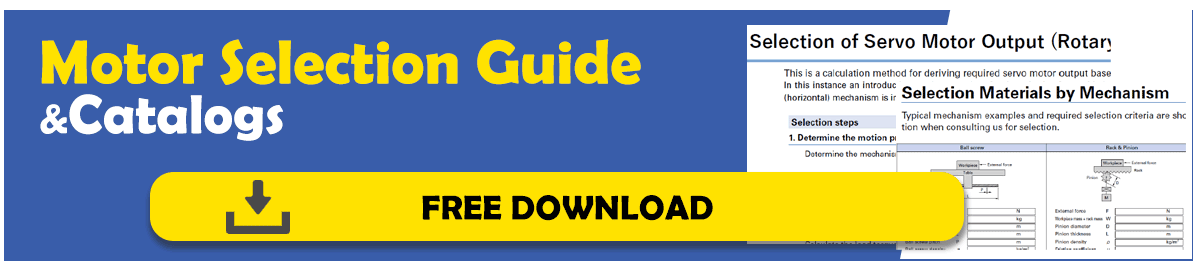
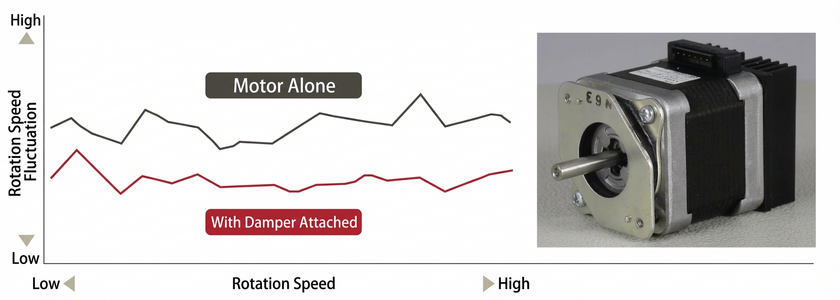
Rubber dampers, which are vibration-isolating materials, are installed on the motor mounting surface.
By isolating motor vibration from the housing, this approach is effective in reducing vibration and noise. It also enables stable torque to be maintained in high-speed operating ranges. If motor heat generation becomes an issue, heat dissipation fins can also be added as a thermal countermeasure.
This solution is used in applications such as copiers, semiconductor manufacturing equipment, electronic component assembly machines, and medical devices.
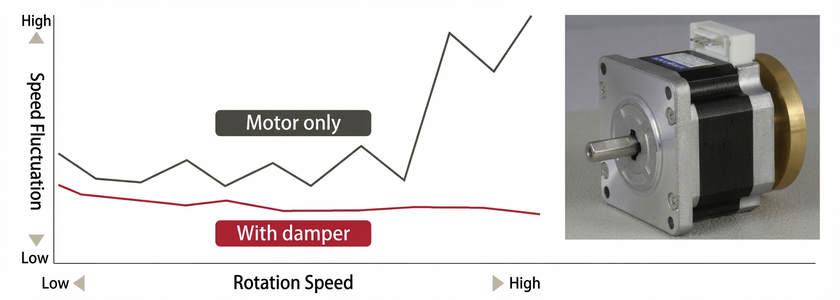
By installing a rotary damper on the non-output shaft side of the motor, vibration in stepping motors can be suppressed, providing effective reduction of vibration and noise while stabilizing high-speed torque. This configuration also offers the advantage of dissipating motor heat to the equipment side.
* Installing a rotary damper requires the motor to have a double-ended shaft.
This solution is used in applications such as PCB/wafer transfer systems, semiconductor manufacturing equipment, and electronic component assembly machines.
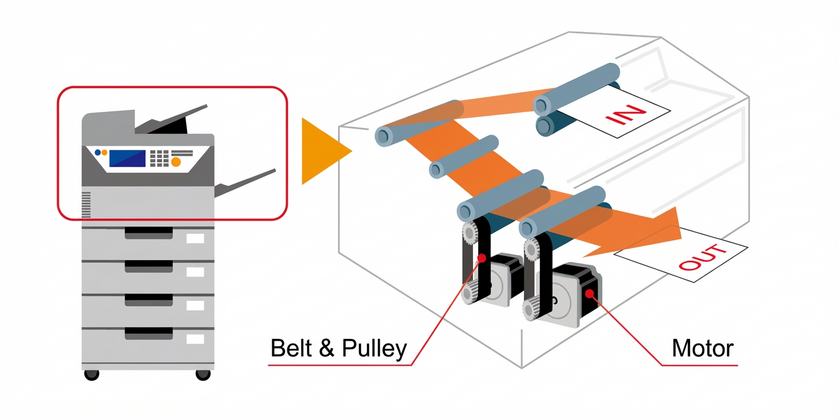
This is a case study in which a stepping motor is used for the paper feed shaft of a commercial printer. To suppress motor vibration, noise, and temperature rise, a customized motor equipped with mounting-surface dampers and a heat dissipation plate was adopted.
Please feel free to consult us about any challenges you may face with customization.
Leveraging our extensive customization expertise, we can proactively propose functional improvements.
Through SANYO DENKI’s customization solutions, we help enhance the competitiveness of our customers’ equipment.
* Please note that customization may be subject to certain conditions, such as minimum order quantities. Contact us for further details.
Cooperation: Sales Headquarters, Servo System Business Group, SANYO DENKI CO., LTD.
Update date: /Release date:

Aiming to be the world's No. 1 in manufacturing
Technical capabilities that enable advanced customization
Our 100th anniversary soon
Global Network