Knowledge
[Basic Knowledge for Selecting a Motor]



In the fields of agriculture and food manufacturing, ensuring food safety and improving productivity amid labor shortages are the most critical challenges.
In the agricultural sector, workforce shortages and the lack of successors have made automation an urgent priority. Meanwhile, in the food manufacturing industry, stricter hygiene management driven by mandatory HACCP requirements has accelerated the adoption of automation technologies to improve operational efficiency.
At the core of such automation are control motors. Stable and precise motion control helps reduce variations in packaging and filling processes, contributing to improved quality across the entire system. In addition, the use of waterproof motors enables operation in applications exposed to water, such as washing equipment, as well as in outdoor environments.
In this article, we provide insights into control motor selection by introducing common motor types, their characteristics, key selection points, and case studies.
There are several types of control motors used in agricultural machinery and food processing equipment. Understanding the characteristics of each type and selecting the most suitable motor for the application are essential for optimal system performance.
Stepping motors are control motors with a simple structure that operate using open-loop control. They are well suited for repetitive motions and light-load applications. In agricultural machinery and food processing equipment, stepping motors are effective in situations that require consistent positioning, such as material conveyance on packaging lines and filling processes. Compared with servo motors, they are more cost-effective and offer excellent cost performance. One limitation of stepping motors is the risk of position deviation, step-out, and vibration. As a result, they are generally inferior to servo motors in terms of control accuracy.
For these reasons, stepping motors are the most widely used control motors in agricultural machinery and food processing equipment.
Servo motors are capable of highly precise control of position, speed, and torque.
By using closed-loop control with high-resolution encoders, they achieve both accurate positioning and fast response. In agricultural machinery, servo motors are well suited for applications that require precise control, such as precision seeding and automated harvesting robots. In food processing equipment, they are commonly used in robot arms, alignment mechanisms, and other processes demanding high accuracy. On the other hand, compared with stepping motors, servo motors are higher in cost. In addition, the control system tends to be more complex.
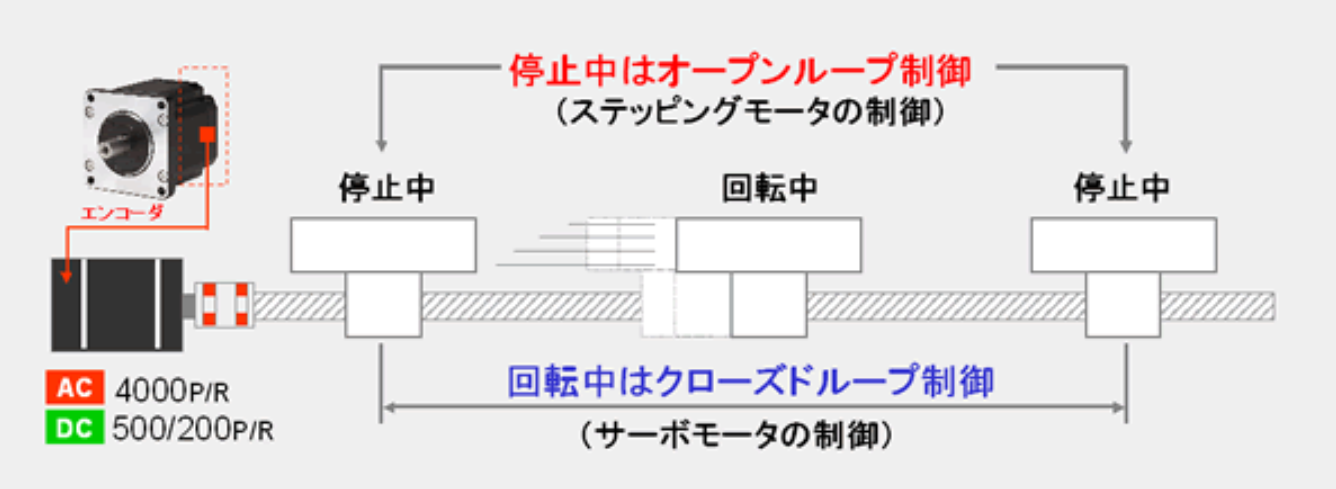
Closed-loop stepping motors use a control method that automatically switches between closed-loop control during rotation and open-loop control when stopped. This type of motor combines the advantages of both servo motors and stepping motors.
Compared with stepping motors, closed-loop stepping motors offer step-out-free operation, reduced vibration, and lower noise levels.They provide high reliability and high accuracy, enabling smooth motion similar to that of servo motors. In applications that do not require the full functionality and performance of servo motors, they also allow for the construction of more cost-effective systems. In addition, closed-loop stepping motors can optimally control motor current according to the load, making them well suited for applications such as mixing viscous liquids in agricultural machinery and food processing equipment.
| Motor Type | Accuracy | Responsiveness | System Difficulty | Cost | Frequency of Use |
|---|---|---|---|---|---|
| Stepping Motors | Medium | Medium | Low | Low | Many |
| Servo Motors | High | High | High | High | Small |
| Closed Loop Stepping Motors |
High | High | Medium | Medium | Medium |
| Motor Type | Advantages | Limitations |
|---|---|---|
| Stepping Motors |
|
|
| Servo Motors |
|
|
| Closed Loop Stepping Motors |
|
|
In agricultural and food manufacturing environments, equipment is often exposed to moisture, humidity, and dust. For this reason, motors with sufficient waterproof and dustproof performance are frequently required. In particular, food manufacturing facilities regularly carry out high-pressure washing as part of HACCP-compliant hygiene management, which makes it essential for motors to have a structure that can withstand these conditions.
SANYO DENKI offers a wide lineup of control motors with protection ratings ranging from IP40 to IP67, enabling users to select the most suitable motor for their operating environment.
*Note: IP40 provides protection against solid objects only and does not offer protection against water ingress.
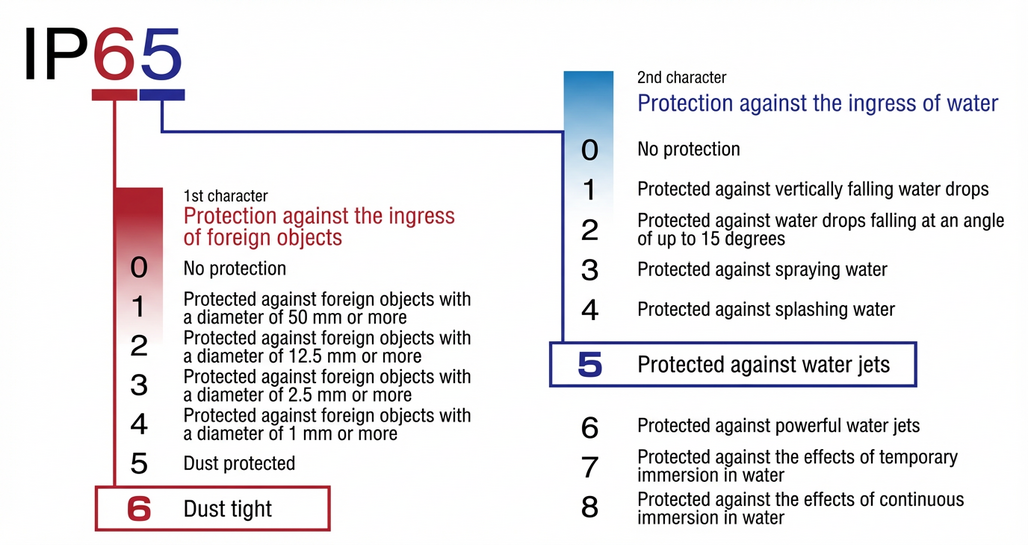
IP Protection Ratings: Overview and Reference Table
This section introduces typical application examples and explains how different types of motors are used in agricultural machinery and food processing equipment.
*Note: The examples shown here are for reference only. The most suitable motor depends on the specific equipment design and operating environment.
• Recommended motor: Stepping motor
• Reason: It is necessary to maintain consistent seed spacing and planting depth, but extremely high precision at the millimeter level is not required.
• Recommended motor: Servo motor
• Reason: High responsiveness is essential to adjust the cutting position and operating speed in real time.
• Recommended motor: Stepping motor
• Reason: Simple control is often sufficient for positioning and conveying fruit, making stepping motors a low-cost and practical choice.
• Recommended motor: Stepping motor
• Reason: Tray conveyance is often performed at low speeds, and open-loop control is generally adequate for this type of application.
• Recommended motor: Closed-loop stepping motor
• Reason: Liquid viscosity and volume can change during operation. For this reason, closed-loop stepping motors are well suited for applications that require stable operation under varying loads.
• Recommended motor: Stepping motor
• Reason: In many cases, low-speed operation is sufficient, and open-loop control can be used effectively.
• Recommended motor: Stepping motor
• Reason: Step control is ideal for adjusting the amount of liquid or paste in discrete increments. When high-precision dosing or high-speed operation is required, servo motors or closed-loop stepping motors are selected.
• Recommended motor: Stepping motor, closed-loop stepping motor
• Reason: Cutting position and speed are typically controlled in discrete steps, and in many cases, the level of precision provided by servo motors is not required. As a result, stepping motors are often selected with cost efficiency in mind. However, when grease generated during cutting increases the load, or when high-precision control or high-speed operation is required, servo motors or closed-loop stepping motors are more suitable.
• Recommended motor: Stepping motor
• Reason: Ingredient positioning and dispensing timing can be controlled using open-loop control, making stepping motors suitable for this application.
• Recommended motor: Closed-loop stepping motor
• Reason: Accurate control of filling volume is required, and closed-loop stepping motors are well suited for handling load fluctuations during operation.
• Recommended motor: Stepping motor
• Reason: High-speed operation is not required in many cases, making open-loop control sufficient and cost-effective.
• Recommended motor: Stepping motor
• Reason: Label application positions can be easily adjusted using step control, allowing for simple and stable operation.
• Recommended motor: Servo motor
• Reason: These applications require multi-axis motion and highly accurate positioning, making servo motors the optimal choice.
Recommended article: Enhancing Food Factory Capabilities with Stepping Motors
SANYO DENKI offers a comprehensive lineup of control motors designed to meet the diverse needs of agricultural machinery and food processing equipment.
The SANMOTION F series delivers high torque with low vibration and low noise. By reviewing component configurations and applying optimized design, the motors achieve significant size and weight reduction while maintaining high torque output.
Stepping motor drivers in the SANMOTION F series comply with overseas product safety standards, including UL standards, as standard. The series offers a wide range of models with protection ratings from IP40 to IP65. In addition, flexible customization is available to meet individual customer requirements, such as shaft machining and damper mounting.
Learn more: Motor Customization Examples
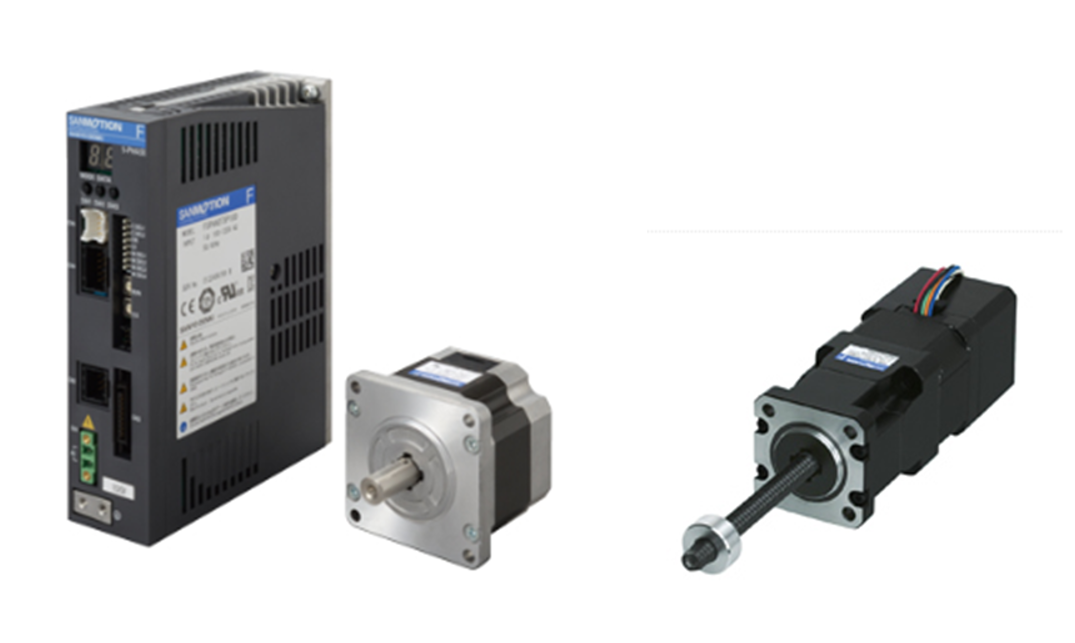
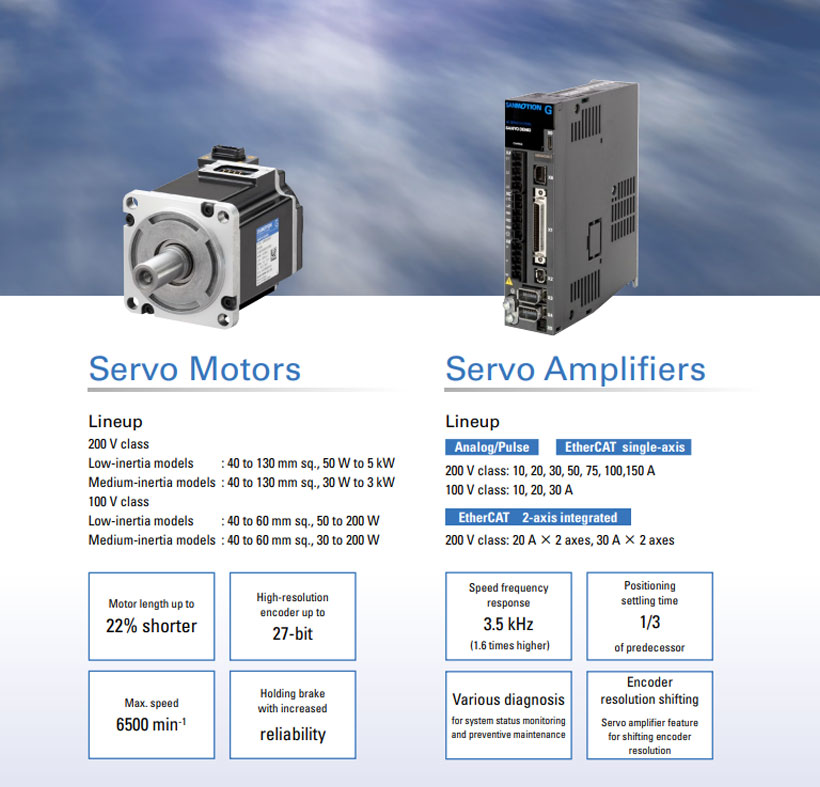
SANMOTION G is an AC servo system that delivers advanced servo performance while improving energy efficiency.
The system achieves a speed frequency response of 3.5 kHz, which is 1.6 times higher than our previous model, and offers high-resolution encoders ranging from 23-bit as standard to a maximum of 27-bit, representing up to a 64 times higher resolution compared with our previous model. In addition, its compact and lightweight design contributes to downsizing equipment and enabling space-saving system designs.
The servo motor itself in the SANMOTION G series is rated IP67, providing excellent protection for use in demanding environments.
* Previous model: AC servo system SANMOTION R
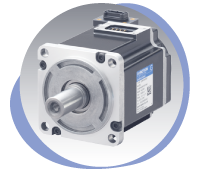
SANMOTION Model No. PB is a stepping motor that incorporates the advantages of both servo motors and stepping motors.
Equipped with a position detection sensor, the motor automatically switches between closed-loop control during operation and open-loop control when stopped.
As a result, step-out does not occur as it does in stepping motors, helping to reduce vibration and improve overall system reliability.
The motor optimizes current according to the load. The motor itself is rated IP40, providing protection against solid objects.
A food processing equipment manufacturer, Company H, faced the challenge of increasing processing speed in order to keep up with higher production volumes during peak seasons. With conventional induction motors, it was necessary to increase motor capacity to compensate for insufficient torque at low speeds. This raised concerns about heat generation and its impact on food quality.
To address these issues, SANYO DENKI proposed the closed-loop stepping system “SANMOTION Model No. PB.” Compared with the existing motor, the new system reduced size to one-fifth and weight to one-tenth, while also suppressing heat generation. In addition, speed adjustment can be easily performed using a switch.
As a result, the processing speed doubled, and the equipment was successfully downsized.
Stepping Motor Case Study | 095 | What Motor Enables 5x Smaller Size and 10x Lighter Weight?
* This case study was originally published in 2019.
A food conveying equipment manufacturer, Company B, faced challenges in reducing cycle time and lowering costs. Although servo motors were adopted for a new product, the company lacked sufficient experience with servo motor selection and had concerns about whether the motors were appropriately specified.
With selection support from SANYO DENKI, it was determined that the motors had been over-specified. By optimizing the capacities of both the motor and the amplifier, significant cost reductions were achieved. In addition, the system was upgraded to provide IP65-rated waterproof performance, enabling compatibility with washdown requirements.
AC Servo Motor Case Study | 079 | How Optimizing Motor and Amplifier Capacity Reduced Costs in an Automatic Sorting System
* This case study was originally published in 2018.
A blade grinding machine manufacturer, Sanko Manufacturing Co., Ltd., wanted to advance the automation of its grinding machines but lacked the necessary know-how. To address this challenge, SANYO DENKI proposed a solution consisting of a linear-drive stepping motor, a four-axis integrated driver, and the motion controller “SANMOTION C S100.”
In addition to the hardware, SANYO DENKI provided technical support to develop a control method that could replicate the skills of experienced operators. This approach enabled both automation and space-saving design, ultimately leading to the successful completion of the product development.
Motion Controller Case Study | 112 | How a Compact Motor and Dedicated Technical Support Led to Successful Product Development
* This case study was originally published in 2021.
Supervised by: SANYO DENKI CO., LTD., Sales Division, SANMOTION Group
Release date:

Aiming to be the world's No. 1 in manufacturing
Technical capabilities that enable advanced customization
Our 100th anniversary soon
Global Network